
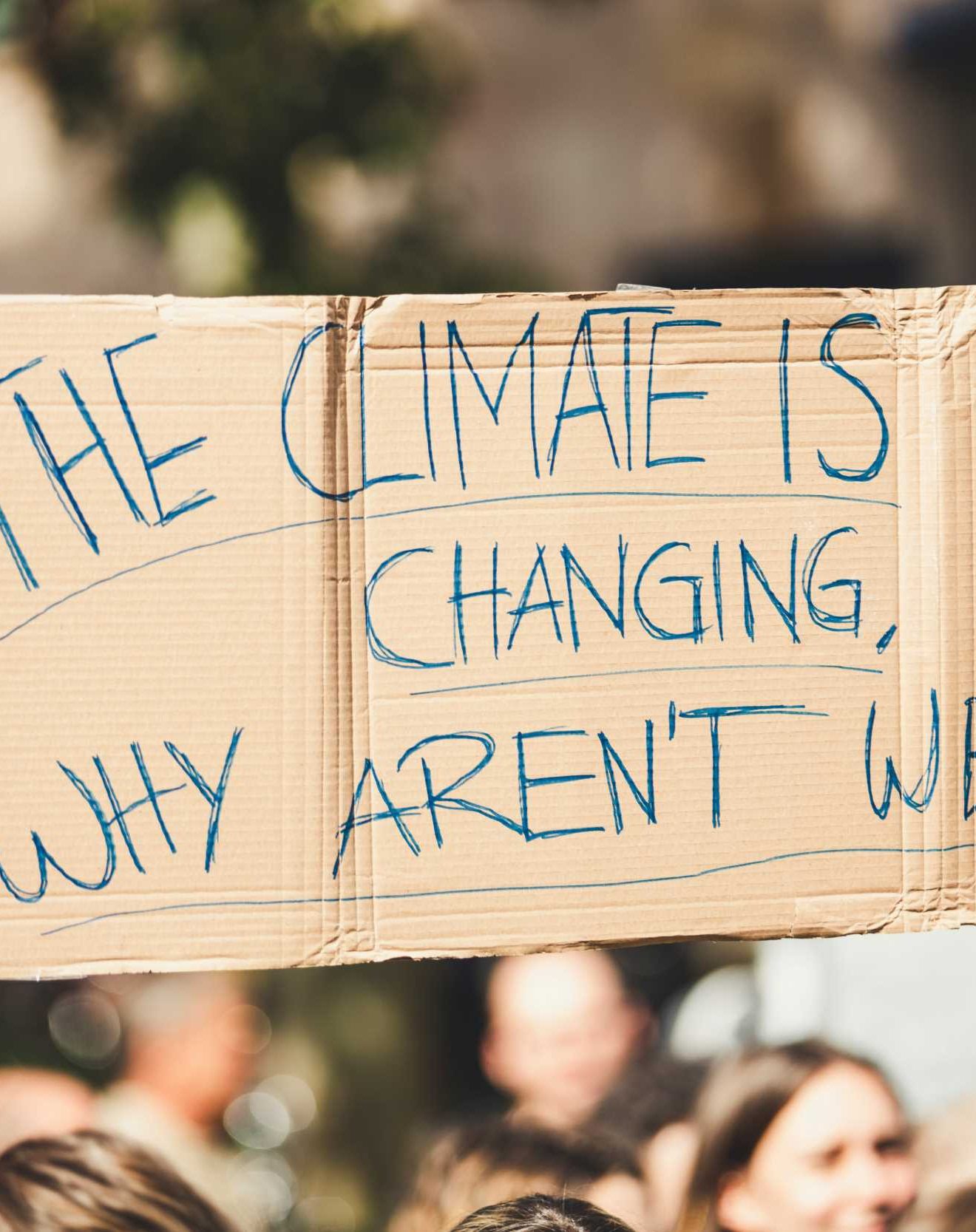
Addressing this question through the lens of Irish climate governance offers a salient case in point. For decades, it has cycled through repeated commitments to greater moral responsibility and targeted action, only to discover that the chosen means are not enough. In the meantime, we have reached the threshold of a world that is on average 1.5 °C hotter than it was a couple of centuries ago, accelerating on a path towards being 2 °C hotter by 2050 and more than 3 °C hotter by 2100. Those are planetary averages; land heats up at twice the rate of oceans, and so as terrestrial beings, we are staring at a future life that is 6 °C hotter. This is an unrecognisable world.
Governance doesn’t deny this trajectory. In fact, governance through resourcing science, research and knowledge dissemination enables us to see it. Though there is at least one government that publicly rejects the trajectory as a hoax, and some political parties are overtly sceptical. But most governments identify the human contribution to changing the climate as a legitimate issue. However, governance is different to government, and there is often tension between the two. Government constrains governance. That makes government an obvious target. But is government the primary bearer of agency? Or has the narrative that governments follow been pre-written? If so, by whom and in whose interests?
The air we breathe
One of the more obvious constraints on climate governance is that its selected means must align with a definition of national progress, where economic growth and rising living standards are akin to the air the nation breathes. They are fully assumed as the purpose of governance and the means selected to address any other issue must align with that purpose. Governments don’t even have to argue the case. So the scope for climate governance is narrow.
Having economic growth and rising living standards as the national purpose doesn’t mean that everyone benefits. By definition, having growth and rising living standards as a goal means that there can never be enough. If there were enough, the purpose would be redundant. To keep the purpose alive, we are in a permanent state of want or deficit. Deficits in housing, healthcare, education, energy infrastructure, hospitals, social care, EV charging points, everywhere….We simply cannot grow quickly enough.
Therefore, as an example, we introduce a Critical Infrastructure Bill that means the political system can choose to disregard the climate impacts of projects deemed strategically important. This is the context within which Irish climate governance sits. It is an optional appendix to the main item.
In whose interests…
The point might be that the interests served by a national purpose of growth and ever-rising living standards have become so deeply embedded in the architecture of the system that they cannot be moved. They have become the linchpin of the system. This means that they are beyond politics. That’s real power!
It means that the economists, politicians and corporations that evangelise the national purpose are more like ministers to the system than independent agents with an interest in the system. The options they promote arrive at them pre-coded. They do not originate from them. Options that do not carry the system’s code won’t make it onto the agenda. There is no easy disentanglement from this, for anyone, including me.
Let’s gather our thoughts
The system is built on a paradigm that believes more is always better. The paradigm is maintained by a grammar of growth metrics and indicators, of which GDP is primary. Institutions across markets, finance, pensions, public services, technology and defence are all growth-dependent and are therefore fluent in the grammar. Moral appeals to a higher ambition, which may well be genuine, inevitably wilt in the face of institutional constraint.
If the lynchpin were removed, the institutions would crumble, resulting in a socio-economic collapse. The prospect of this creates more terror than the climate collapse we have entered. If governance were to steer towards an alternative to growth based on say…sufficiency, then the grammar of metrics and indicators would flash emergency red. Even if we could move towards a trajectory of planetary repair, it would feel like we were dying. In having us believe we were dying, the system would save itself.
The future of agency
Based on this argument, governance, governments and institutions (as we know them today) cannot reorient; they can only act within the contours of the path they are already on. If this is true, then agency, or the potential for agency, may remain within individuals and maybe informal communities. This raises the question of what might help with enlivening that agency, helping it to move from latent to actual? This might be an important question. Because the sense of inevitability that comes with powerlessness is just a sense. It is not really real. Nobody can assume that everything, or even anything, is settled. Not even power itself, because if everything were settled, power itself would be redundant.
To enliven agency, I believe a diagnosis of the structures that make choices for us, for our governments and for our institutions might help. We need to understand how these structures arose. Who benefits from them? Who loses? And who has an interest in these questions not being asked? If we can see the structure as it is, even if it’s just to sit with it, something might shift.
Share this on...